Telegram Banned in India Until 22 June: What the NEET Re-Exam Order Means
Published 15 Jun 2026 · Updated 16 Jun 2026
India has placed a temporary block on Telegram. As of 16 June 2026, the Ministry of Electronics and Information Technology (MeitY) ordered access to the messaging app to be restricted across the country until 22 June 2026. The order was issued under Section 69A of the Information Technology Act, 2000, and it is tied to one specific event: the NEET (UG) 2026 re-examination, which is scheduled for 21 June.
If you opened Telegram today and found it slow, unreachable, or blocked by your internet provider, this is why. The short version is that this is a narrow, time-bound measure, not a permanent ban on the app. Below is a clear, plain-language explanation of what the order covers, why it happened, and what it means for your messages and your account.
What exactly did the government order?
According to news reports, there are two separate parts to the action, and it helps to keep them apart.
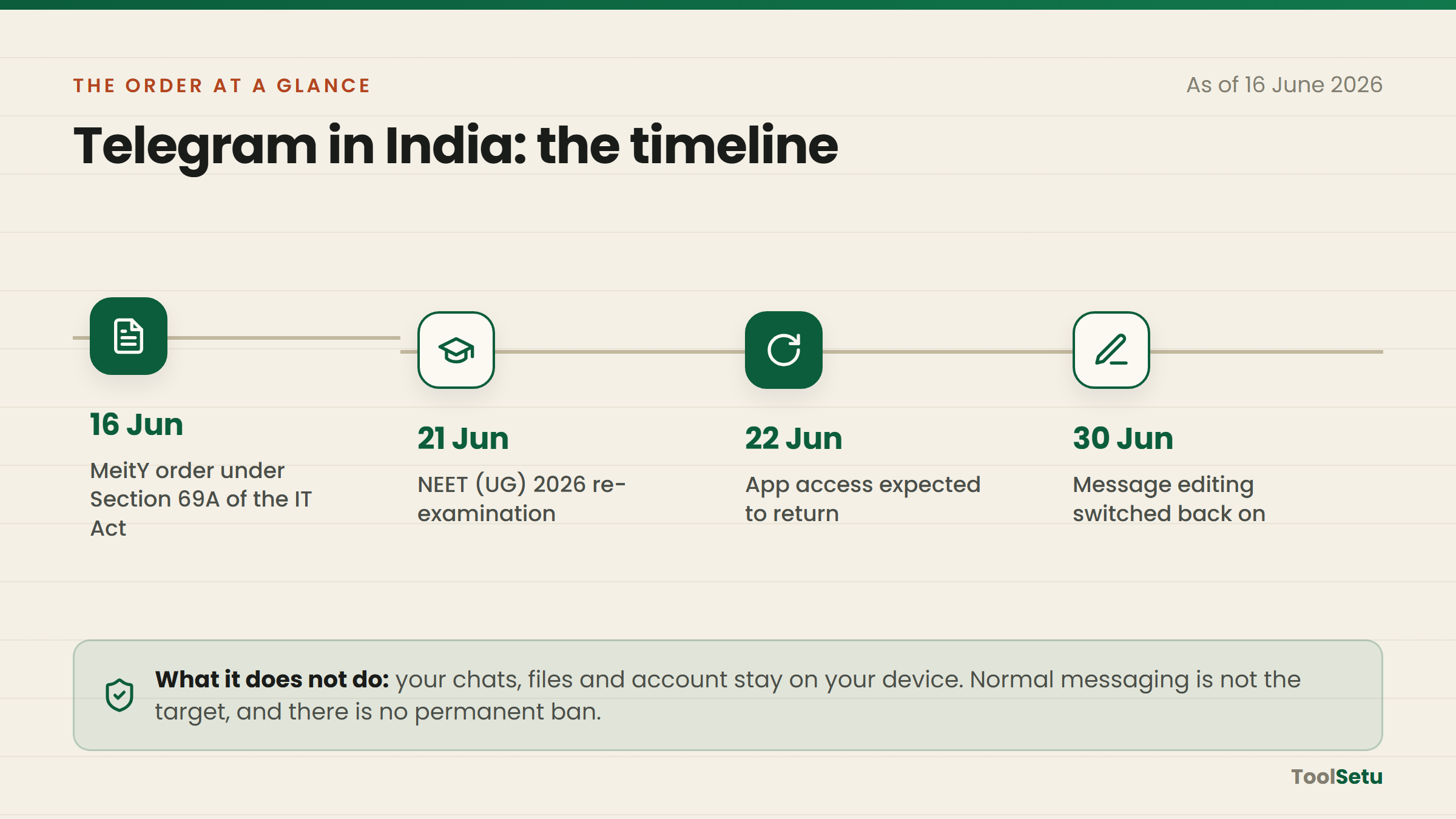
- A block on access to Telegram in India, in force until 22 June 2026. This is the part most people will notice, because their network may stop the app from connecting.
- An order to disable the message editing feature for Telegram in India until 30 June 2026. This stops anyone from quietly editing an old message after the exam to make it look like a question paper was posted earlier than it really was.
Both orders use Section 69A of the IT Act, which lets the government direct intermediaries to block access to specific content or services in the interest of public order and the prevention of crime. The block is described as a last resort, used only after repeated takedown requests for individual channels did not produce enough cooperation.
Why was Telegram blocked in India?
The reason is an exam fraud problem, not a dispute about Telegram as a company. Ahead of the NEET (UG) re-exam, several Telegram channels were openly claiming to sell the question paper and demanding money from anxious students and parents. Reports name channels such as "PAPER LEAKED NEET", "Re-NEET 2026", "Private Mafia" and "REE NEET MAFIAA".
The pattern is a classic scam. A channel promises early access to the paper, collects payments, and after the exam edits its older posts to insert the real questions. It then points to those edited posts as proof that it had the paper all along, which helps it trap the next round of victims. Disabling message editing is aimed squarely at breaking that trick.
The National Testing Agency (NTA), which conducts NEET, was blunt about it. In its statement the agency said that "there is no such paper available outside the secured examination chain. The promise of any such material is, in every instance, a fraud." The coordination of the channel takedowns was handled with the Indian Cyber Crime Coordination Centre (I4C).
Is Telegram banned permanently in India?
No. This is a temporary, targeted restriction with fixed end dates. The access block is set to lift on 22 June 2026, one day after the re-exam, and the editing restriction is set to end on 30 June 2026. There is no announcement of a permanent ban on Telegram in India.
It is worth being precise here, because headlines can make a short block sound like a shutdown. What has happened is a calendar-bound measure built around a single exam, similar in spirit to the way mobile internet or specific apps are sometimes restricted around sensitive events.
What the block does and does not affect
The authorities have stressed that the goal is to stop fraud channels, not to read or delete the ordinary chats of regular users. Based on the official position:
- Your existing chats and files are not deleted. A network-level block stops the app from connecting on that network. It does not erase what is already on your phone.
- Sending and receiving new messages is described as not being the target of the action. The measure is aimed at access during the window and at the editing feature being misused.
- Your account is not banned. The restriction is on access from India during the window, not a ban on individual Telegram accounts.
In practice, whether the app connects at all during the window depends on how your internet provider implements the order. Some users may find it fully unreachable, others may see it work intermittently.
When will Telegram work normally again?
Going by the orders, normal access is expected to return after 22 June 2026, and the message editing feature is expected to be switched back on after 30 June 2026. Dates in matters like this can be extended or lifted early, so treat them as the current position rather than a fixed promise. The reliable way to confirm is to check official government and NTA communications and reputable news outlets rather than forwarded messages.
A reminder for students and parents: do not pay for any "leak"
This whole episode exists because scammers found buyers. The single most useful thing you can do is to internalise the NTA's point: a genuine paper does not circulate outside the secure chain, so anyone selling one is running a fraud. Some practical habits that protect you:
- Never pay money to a channel, group, or stranger that promises an exam paper, a guaranteed result, or a "fixed" seat.
- Do not share documents like your admit card, Aadhaar, or marksheet with such accounts. If you have to share an ID anywhere, learn how to use a masked Aadhaar so the full number is not exposed.
- Protect the accounts that matter with a unique, strong passphrase. Our guide to creating a strong password shows a simple method you will actually remember.
- If you have already paid a scammer, report it on the national cybercrime portal (cybercrime.gov.in) or call 1930, and keep every screenshot. A clear written record helps, and you can adapt our consumer complaint letter format for the paper trail.
What this means for everyday Telegram users
If you use Telegram for family groups, study material, or work, the honest takeaway is that this is a short interruption tied to one exam, not a sign that the app is leaving India. If the app will not connect this week, you do not need to delete it or migrate everything in a panic. Your data stays on your device, and access is expected to return on schedule.
For anything sensitive, this is also a good moment to remember that messaging apps are only as private as the habits around them. Be careful what you forward, be skeptical of any account asking for money or documents, and verify big claims through official sources before acting on them.
This article explains a developing news event as of 16 June 2026 and is for general information. Dates and the scope of the order may change. For the current position, refer to official MeitY and NTA notices and established news outlets.